


Pet loss can hit hard, but your attachment style often shapes how it hits. If you feel stuck in guilt, numbness, panic, or mood swings after a pet dies, that pattern may connect to the way you handle closeness, stress, and comfort.
Here’s the short version:
- Secure attachment: I’m more likely to feel the pain, lean on people I trust, and slowly return to daily life.
- Anxious attachment: I may get caught in guilt, longing, and repeated “what if” thoughts.
- Avoidant attachment: I may go quiet, numb, or throw myself into work instead of feeling the loss.
- Disorganized attachment: I may swing between overwhelm and shutdown, sometimes fast.
A big issue is that pet grief is often dismissed. In the U.S., many people still hear that a pet was “just an animal,” even though about 66% of U.S. households own a pet according to recent industry data. That gap can leave grief feeling private, heavy, and hard to explain.
The main takeaway: I cope better when I match support to my attachment style. That can mean timed reflection, private rituals, grounding exercises, journaling, support groups, or therapy when grief starts to disrupt daily life.
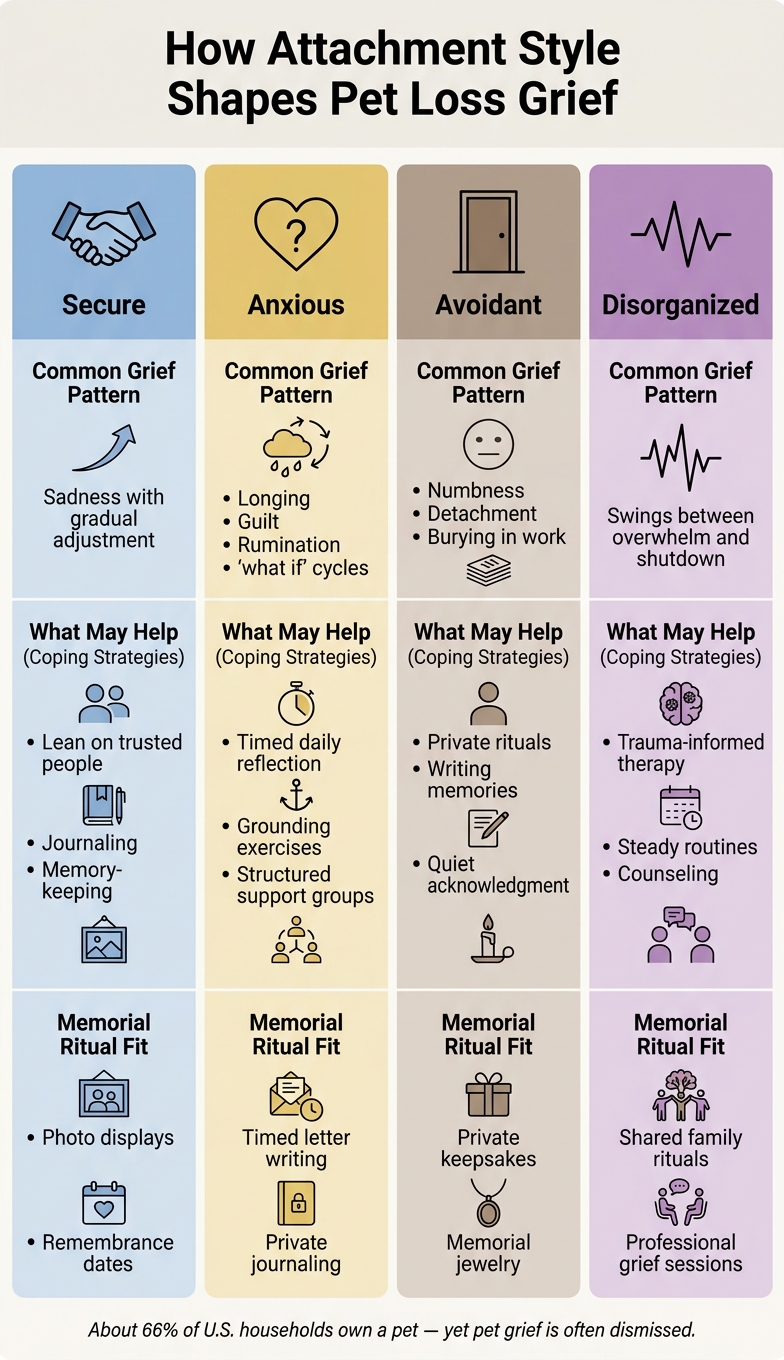
Attachment Styles & Pet Loss: Grief Patterns and Coping Strategies
What Losing Your Dog Reveals About Your Brain (The Grief Science)
sbb-itb-c538f2f
Quick comparison
| Attachment style | Common grief pattern | What may help |
|---|---|---|
| Secure | Sadness with gradual adjustment | Support from close people, memories, journaling |
| Anxious | Longing, guilt, rumination | Set reflection time, grounding, group support |
| Avoidant | Numbness, distance, shutdown | Private grief rituals, writing, quiet acknowledgment |
| Disorganized | Swings between distress and shutdown | Steady routines, counseling, trauma-aware care |
If I know my pattern, I have a better shot at choosing support that fits instead of forcing myself to grieve in a way that does not.
How each attachment style shapes grief after a pet dies
Here’s how those attachment patterns often shape grief after a pet dies. They also hint at different coping needs, which matters if the goal is healing.
Secure attachment: sadness, connection, and gradual adjustment
People with a secure attachment style often grieve in a way that is painful but still steady enough to work through. They let themselves feel sad, hold on to the pet’s memory, and slowly ease back into daily routines. Even with secure bonds, pet loss can feel deep and overwhelming. But for many people, the grief tends to soften over time. Understanding the 7 stages of pet loss grief can help navigate this transition.
Anxious and avoidant attachment: intense yearning or emotional shutdown
Anxious attachment can make pet loss feel especially intense. Common reactions include longing, guilt, shame, and replaying what happened again and again. That kind of rumination can make relief hard to find. Reassurance may help for a moment, but it usually doesn’t stop the cycle.
Avoidant attachment can look very different on the surface. Instead of feeling flooded by emotion, a person may go numb or seem detached. They might throw themselves into work or home tasks, keeping grief at a distance. But pushing grief down doesn’t make it disappear. It often comes back later in a stronger wave.
Disorganized attachment: mixed reactions and longer-lasting distress
Disorganized attachment can bring mixed reactions that feel hard to make sense of. A person may swing between heavy waves of grief and periods of shutdown, sometimes in the same day. Fear, anger, and helplessness can all show up at once, which can leave mourning feeling messy and hard to predict.
This style can also be linked to grief that lasts longer and gets in the way of daily life. When there isn’t a steady emotional pattern to lean on, loss can feel chaotic. That’s why the next step is matching coping strategies to the attachment style. For those who struggle to express their feelings, exploring art therapy ideas to cope with pet loss can provide a creative outlet for healing.
Coping strategies matched to each attachment style
Attachment style doesn't just shape grief. It can also point to the coping tools most likely to help.
What helps people with secure and anxious attachment styles
People with secure attachment often do best when they let grief move at its own pace. That may mean leaning on close friends or family, while also holding on to the bond through memory.
With anxious attachment, more structure often helps. Grief can bring intense yearning and anxiety, so one useful tool is setting aside a daily block of time to reflect on the loss, then returning to normal tasks. Grounding exercises and structured support groups can also help keep grief from taking over day-to-day life.
What helps people with avoidant and disorganized attachment styles
With avoidant attachment, the hard part is often letting grief in at all. People with this style may need private acknowledgment, especially when others minimize the loss. Writing down memories or keeping a short personal journal can make space for grief without pushing someone into public mourning.
For disorganized attachment, professional support often helps alongside steady daily routines. Trauma-informed therapy and simple, predictable habits can add a sense of stability when grief feels hard to track and hard to sort through. These patterns also shape which memorial rituals feel grounding, private, or emotionally safe.
The chart below links common coping blocks with responses that tend to fit each attachment style.
| Attachment Style | Common Missteps | Attachment-Matched Strategies |
|---|---|---|
| Secure | Skipping grief or rushing back to routine | Balanced grieving, journaling, trusted social support |
| Anxious | Rumination and overwhelm | Set daily reflection time, grounding exercises, structured support groups |
| Avoidant | Shutting down or minimizing the bond | Private rituals, writing memories, low-pressure acknowledgment |
| Disorganized | Emotional swings and instability | Trauma-informed therapy, simple stabilizing routines |
Using memorial rituals to support healing and maintain connection
Love can keep going after loss. Continuing bonds looks at grief as an ongoing relationship, not a clean break. Memory, ritual, and symbolic objects can help people hold that connection in a way that supports healing. And not every ritual works the same way for every person.
Memorial practices that fit different attachment styles
It helps to match the ritual to how someone tends to grieve. Some people want something visible and shared. Others need something quiet and private. The table below connects common memorial options to each attachment style and shows how they can fit into daily life at home in the U.S.
| Memorial Option | Attachment Style Fit | How it fits at home |
|---|---|---|
| Photo Displays / Remembrance Dates | Secure | Visible tribute in common areas; annual tradition |
| Timed letter writing | Anxious | Private journaling to process yearning; prevents constant activation |
| Private keepsakes or memorial jewelry | Avoidant | Subtle, personal items for quiet reflection |
| Shared rituals or counseling | Disorganized | Family ceremonies or professional sessions to stabilize mixed reactions |
| Urns and burial markers | All Styles | Permanent, respectful placement in a home or garden |
For anxious attachment, timed letter writing can give grief a place to go without letting it take over the entire day. It creates space to process yearning, but with some boundaries.
For avoidant attachment, private keepsakes like memorial jewelry can honor the bond without asking someone to show their feelings in public. That can feel more natural and less forced.
When physical memorials can help with grief
For some people, a physical memorial is the clearest anchor. An urn, a burial marker, or a piece of jewelry can offer a steady point for remembrance. Sometimes that matters even more when pet loss isn't fully recognized by family, friends, or the broader community. That kind of response can create disenfranchised grief.
A physical memorial can also help validate the depth of the bond. It says, in a simple and concrete way, this relationship mattered. Pet Memory Shop offers respectful options for families who want to honor a beloved pet in a tangible way.
When grief needs extra support and key takeaways
Signs it may be time to seek professional or community support
If your usual coping tools stop helping, it may be time to bring in extra support. Grief after pet loss is normal, but when it starts to feel crushing or hard to carry day after day, support matters.
Attachment style can shape how that grief shows up. For some people, it looks like trouble focusing. For others, it shows up as guilt that won’t let go, pulling away from people, feeling numb, or a heavy sense of helplessness. Those are all signs worth taking seriously.
When grief goes unseen or unnamed, talking with a counselor, doctor, or grief group can help by adding validation and structure.
If you want support that fits the way you grieve, the U.S. has a few different options:
- Pet Loss Companion
- Wolfie's Wish
- attachment-informed therapists
- pet-loss specialists
- Pet Memory Shop's hotlines and phone support list
Final points to remember
Attachment style shapes grief, but it does not define it. Think of it as a guide, not a verdict. It can help you spot healthy ways to overcome pet loss grief that fit how you tend to react under stress.
For example, someone with an anxious style may do better with structured ways to name and contain emotion. Someone with an avoidant style may lean toward quiet, private ways to stay connected. Neither path is wrong.
As author Gary Kowalski writes, "Healing from the loss of a pet is a complex and personal journey." That journey can hold deep mourning and lasting memory at the same time. They come from the same bond.
FAQs
How do I figure out my attachment style?
The resources here don’t explain how to figure out your specific attachment style. Instead, they focus on gentle support, guided meditations, and practical ways to cope with the loss of a beloved pet.
If you’re looking for help processing your feelings and honoring your pet’s memory, Pet Memory Shop offers memorial products and support resources that can bring comfort during this hard time.
Can pet loss trigger old trauma or past grief?
Yes. Losing a pet can stir up old trauma or earlier grief, and it may bring back emotions linked to past losses or unresolved pain.
The bond with a pet often runs deep, so that kind of loss can hit hard. It can bring back feelings of helplessness, guilt, or loneliness. Pet Memory Shop also offers memorial products and loss support resources to help honor your companion.
How long is too long to grieve a pet?
There isn’t one set timeline for grieving a pet. Loss hits people in different ways, and for many, that grief runs deep.
Taking care of yourself, honoring your pet with small rituals, and leaning on support can help. But grief isn’t something you can rush or measure against a fixed deadline. And if it starts to feel too heavy or leaves you feeling stuck, pet-loss support may help.