


If I need to choose one place to start, I use journaling for clarity and meditation for calm. Both can help after pet loss, but they do different jobs.
Here’s the short answer:
- Journaling helps me put grief into words.
- Meditation helps me slow my body and mind when grief feels too heavy.
- Journaling fits best when I want to sort through guilt, regret, memories, or things left unsaid.
- Meditation fits best when I feel restless, numb, anxious, or too drained to write.
- A short routine works well: 2–3 minutes of breathing, then 5–15 minutes of writing or grief journaling.
Pet loss grief can also feel lonely because other people may not take it as seriously as they should. That can make simple self-support tools matter more. Even a few minutes a day can help me feel less scattered and more grounded.
Quick Comparison
| What I need right now | Journaling | Meditation |
|---|---|---|
| Put feelings into words | Yes | No |
| Calm a racing mind | Sometimes | Yes |
| Hold onto memories | Yes | Sometimes |
| Low energy option | No | Yes |
| Process guilt or regret | Yes | Sometimes |
| Short daily reset | Sometimes | Yes |
If I want both calm and clarity, I don’t have to pick only one. I can start with silence, then write one honest sentence.
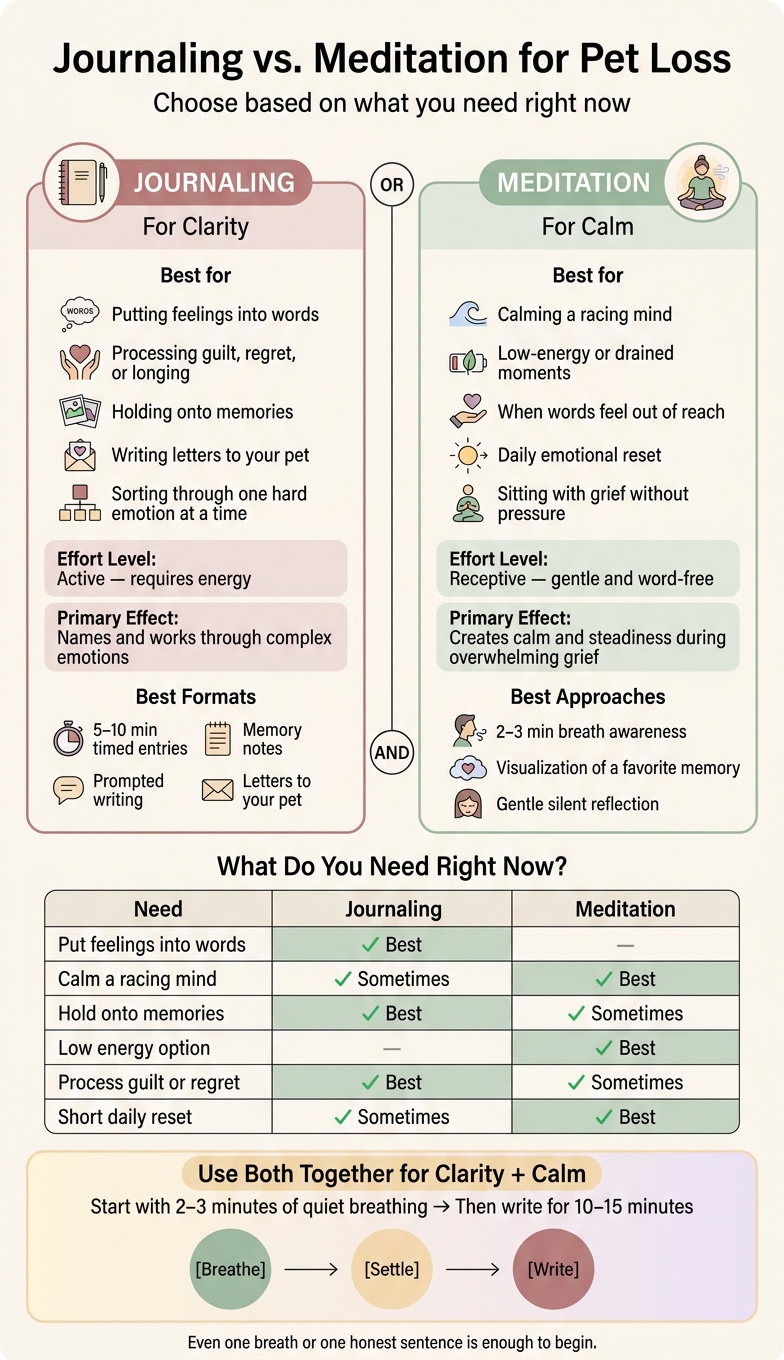
Journaling vs. Meditation for Pet Loss: Which One Do You Need?
Journaling for Pet Loss: What It Does Best
How writing helps you process grief and hold onto memories
When grief is new, guilt, shame, and overwhelm can pile up fast. Writing gives those feelings a place to land. Once you put words on the page, things often feel a little less chaotic. You can slow down, name what hurts, and sort through emotions that seem too big to hold all at once.
Writing also helps you keep the parts of your pet that you don't want to forget, much like pet memorials and remembrances do. Their odd little habits. The way they greeted you. The routines that shaped your day. Those small moments matter, and journaling gives them a home. It helps keep your pet present in your daily memory and preserves that bond.
When journaling works better than sitting in silence
When grief is loud, writing can feel easier than silence. Stillness isn't for everyone. If your thoughts start spinning the second things get quiet, silence can make sorrow feel louder, not gentler. Writing gives that restless energy something to do.
Journaling often helps most when you're trying to sort through one hard emotion at a time, like guilt, longing, helplessness, or anger. It can also help when you want to say what never got said, or when you want to notice how your grief shifts from day to day. For many pet owners, writing letters straight to their pet feels natural and comforting.
Simple journaling formats for grieving pet owners
A blank page can feel like a lot when you're grieving. That's why it helps to start small.
- Brief, structured entries: Set a timer for 5 to 10 minutes and write about how you feel right now. A feelings wheel can help you put a name to what's there, then you can add a few lines.
- Memory notes: Write down favorite routines, stories, sounds, or personality traits you want to keep close.
- Prompted writing: Try a prompt like "What I miss most about today without you" or "Something you taught me."
- Letters to your pet: Write as if you're talking right to them.
If writing feels too active or too intense, meditation can offer a quieter way to steady grief.
sbb-itb-c538f2f
Meditation for Pet Loss: What It Does Best
How meditation helps calm emotions and reduce overwhelm
If journaling leans on words, meditation leans on breath. It gives you a simple way to sit with grief instead of shoving it into the background. On hard days, that can matter a lot.
Meditation doesn't ask you to sort out every feeling or turn pain into neat sentences. It just gives you a quiet pocket of time to pause, breathe, and remember. That makes it a good fit when you need something gentle and word-free.
When meditation helps more than writing
Sometimes, even picking up a pen feels heavy. If you can't focus long enough to write, or if the main problem is a racing heart or a mind that won't slow down, meditation may be the better first move.
Journaling asks for output. Meditation asks much less. You get space for quiet reflection without the pressure of finding the right words. And when grief feels private - or brushed off by other people - meditation or choosing pet loss memorial gifts can give you a small space that's yours alone. That's often why it helps when writing feels out of reach.
Short meditation approaches that feel doable during grief
You don't need a long session for this to help. Even two or three minutes can make things feel a little less intense.
- Breath awareness: Sit quietly and take slow, steady breaths for two to three minutes. You don't need to do anything beyond settling your mind and easing emotional overload.
- Visualization: Picture a favorite memory, like running in a park or relaxing together on the couch. Let that scene hold your attention for a few minutes.
- Gentle reflection prompt: Silently ask yourself what you're grateful for about your time together, then let whatever comes up be there without judging it.
Next, compare journaling and meditation side by side to see which fits your grief style.
Journaling vs. Meditation for Pet Loss: Side-by-Side Comparison
How journaling and meditation differ in emotional effect and daily use
Once you see each practice on its own, the choice gets simpler: journaling helps you put grief into words, while meditation gives grief room to settle. They support different states of mourning. One helps you sort out what you're feeling. The other helps you stay steady when those feelings hit hard.
Strengths and limitations of each tool
The easiest way to pick one is to look at how each affects your mind and how it fits into your day.
| Factor | Journaling | Meditation |
|---|---|---|
| Primary goal | Name and work through complex emotions | Steady yourself during overwhelming grief |
| Effort level | Active - requires energy to translate feelings into words | Receptive - can be done even when you feel disoriented |
| Emotional effect | Puts inner thoughts into words | Creates calm and helps you stay present with your feelings |
| Best use case | Processing memories and regret | When grief feels intense and you need to settle |
| Daily use | Works well with prompts and letters | Works well as a short daily reset |
How to choose based on how you grieve
A good way to decide is to ask yourself what you need right now. If you want to name what's going on inside, journaling can help you use pet loss books with prompts or letters to identify emotions and hold onto your pet's memory. If your feelings feel like too much all at once, meditation may be the better place to begin.
For a lot of people, these two practices work better together than apart. You might journal to identify emotions, then meditate to settle them. That mix can help when you need both clarity and calm. With that choice in place, the next step is building a simple routine you can stick with.
Conclusion: Choosing a Practice and Building a Healing Routine
Key points to keep in mind before you start
After looking at both tools, the choice comes down to what you need most right now: clarity or calm.
Journaling helps you put words to what you feel. Meditation helps you get still enough to begin. Use journaling when you need clarity, and meditation when you need calm. The goal isn't to "move on." It's to make room for grief and love.
A simple combined routine for remembrance and support
Once you know which tool helps most, keep the routine small enough that you can come back to it again and again.
Start with a short meditation or affirmation, then write for 10–15 minutes. A dedicated space at home can make the routine feel more intentional. Even a small pet memorial area, paired with a candle or another simple ritual, can help ground the practice.
Grief after pet loss deserves support, and your routine can begin with one breath or one honest sentence.
Grief Meditation for When a Pet Dies 🌈 SOMEWHERE OVER THE RAINBOW BRIDGE 🦋 Meditation for Pet Loss
FAQs
How do I know which one to start with?
Choosing between journaling and meditation depends on what you need in the moment while grieving.
Journaling can help you put emotions into words. That matters, especially when grief feels messy or hard to explain. Writing things down can help you name feelings like guilt, sadness, anger, or loneliness, which can make those emotions feel more real and less buried.
Meditation works a bit differently. Instead of asking you to explain what you feel, it gives you space to sit with it. It can help you recenter, slow your breathing, find a little calm, and practice self-compassion when your mind is all over the place.
There’s no wrong choice here. Both can honor your bond in their own way.
What if journaling or meditation makes me more emotional?
Feeling more emotional during journaling or meditation is a normal part of grief. In many cases, that’s actually a sign that these practices are helping you put words to what hurts and give those feelings a place to land. So if your emotions feel stronger, it doesn’t mean you’re doing it wrong.
If the experience starts to feel like too much, keep it simple. Try shorter sessions that feel easier to handle. Pet Memory Shop also offers resources like The Pet Loss Companion for extra guidance and comfort.
Can I use journaling and meditation together every day?
Yes. You can combine journaling and meditation as part of your daily healing routine.
They work well together because each one supports a different part of grief. Meditation gives you a quiet space to sit with your feelings. Journaling gives those feelings somewhere to go. Put them side by side, and you have a simple, flexible way to process loss without forcing yourself to "move on" before you're ready.
Used each day, even for a few minutes, they can help care for your heart and spirit while honoring the bond you share with your beloved companion.