


Losing a pet can feel isolating, especially when others don’t fully understand your grief. Local pet loss support groups provide a safe space to share your feelings, connect with others who’ve experienced similar loss, and access resources to help you heal. These groups are led by professionals or peers, offering emotional support, practical coping tools, and opportunities to honor your pet’s memory. Here’s what they offer:
- Emotional Support: Share your grief without judgment and connect with others who truly understand.
- Community Connections: Build lasting friendships with people who respect the bond you had with your pet.
- Practical Tools: Learn coping strategies, memorial ideas, and get professional guidance.
- Resources: Access hotlines, reading lists, and referrals to specialized services.
Whether in-person or online, these groups help you process your loss and find comfort through shared experiences. Reach out to your veterinarian, local shelters, or university programs to find a group near you.
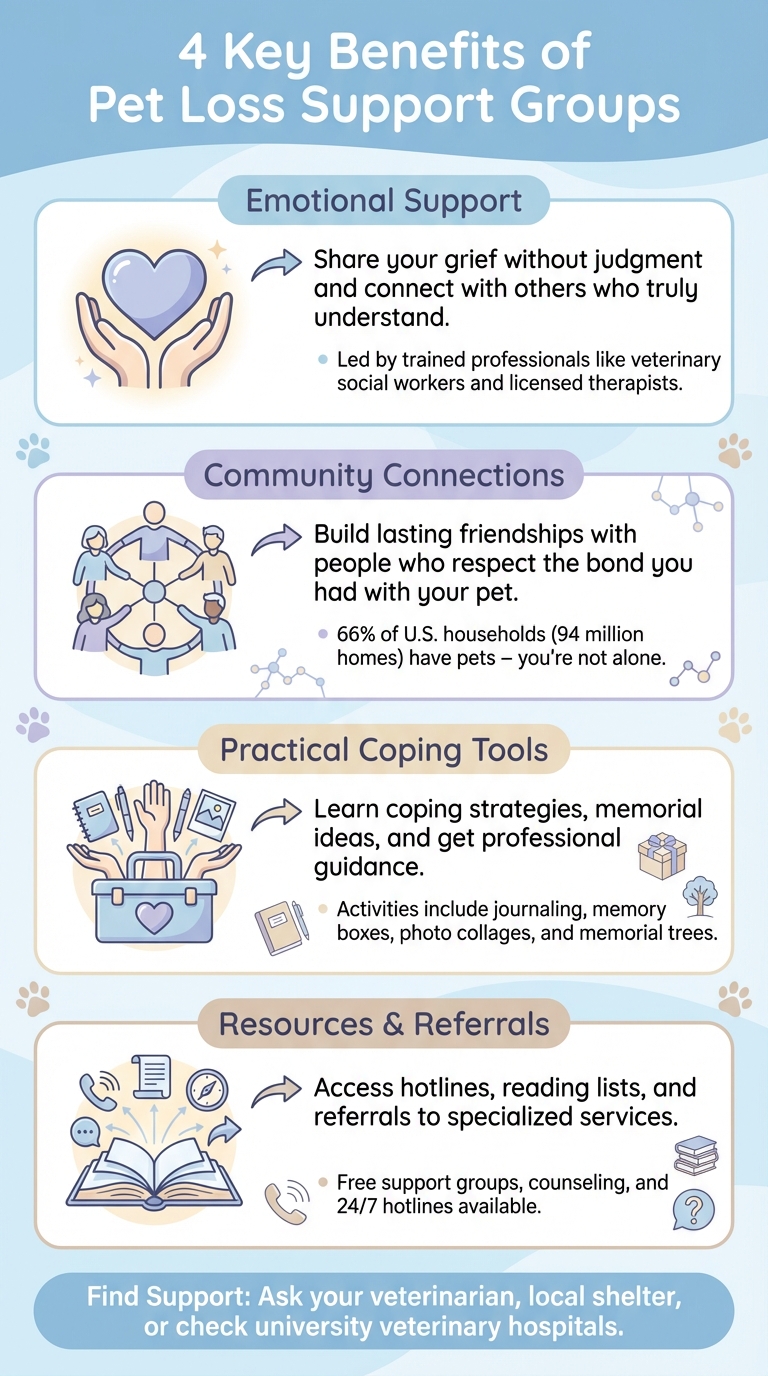
4 Key Benefits of Pet Loss Support Groups
Emotional Benefits of Local Pet Loss Groups
A Safe Space to Express Your Grief
Losing a pet can feel like an overwhelming experience. Local pet loss support groups offer a compassionate and judgment-free space where you can openly share your feelings and process your grief.
These groups are often guided by professionals trained in grief counseling, such as veterinary social workers or licensed therapists. Dr. Cheryl Balkman, a prominent expert at Cornell University Hospital for Animals, emphasizes the value of these groups:
"It is very rewarding to hear how thankful people are to have someone to talk to that both understands them and doesn't judge them."
Confidentiality and respect are central to these meetings, ensuring that whatever you share stays within the group. The focus isn’t on “fixing” you but on giving you the freedom to grieve at your own pace. This kind of nurturing environment fosters a sense of trust and connection with others who truly understand what you're going through.
Connecting with Others Who Understand
Once you’ve found a space to express your feelings, connecting with others who share similar experiences can further aid in healing. One of the most immediate benefits of these groups is the bond formed with people who understand the depth of your loss.
Hearing others share their stories and emotions can help validate your own feelings. This shared experience, often referred to as “universality,” reminds you that your grief is a natural and normal response to losing a beloved pet.
The power of these connections is evident in initiatives like the virtual support group created by Stephanie Coco, the first veterinary social worker at Cornell University Hospital for Animals. In November 2024, she launched this group to support grieving pet owners. Participant Candice Moraga, who lost her cat Midnight Shadow, shared her experience:
"I've been largely alone in my grief... but then I logged into the meeting, and I swear that meeting is what got me through the holidays."
This sense of community can help ease the isolation that often comes with pet loss. Considering that as of 2025, roughly 94 million U.S. households - about 66% of all homes - include at least one pet, these support groups play an essential role in reminding grieving pet owners that they are not alone.
Building Community and Lasting Friendships
Sharing Stories and Finding Common Ground
Telling your pet’s story can uncover shared experiences with others. You realize that many people have faced similar challenges - whether it’s the quiet of an empty home or the ache of difficult holidays. Sharing these stories reminds you that grief is not something you carry alone.
Reflecting on your pet’s life through storytelling not only helps you process your emotions but also brings you closer to people who truly get it. Unlike the dismissive comments you might hear elsewhere, group members deeply respect the bond between humans and animals. This mutual understanding validates your feelings, making it easier to navigate loss. These shared moments of connection often serve as the foundation for meaningful, lasting friendships.
Creating Support Networks That Last
The connections made in these groups often extend far beyond the meetings themselves. Many participants exchange phone numbers, meeting up for coffee or offering support during tough times. These relationships grow stronger with the presence of "repeat" members - those who return to support newcomers and share their own experiences. Leigh Ann Gerk, a Certified Pet Loss and Grief Counselor, highlights this sense of connection:
"It's amazing how many people exchange numbers after, to have coffee or talk. They find that commonality with each other, which is so special."
Should I Join a Pet Loss Support Group?
sbb-itb-c538f2f
Practical Coping Tools and Resources
Building on the emotional support and connections mentioned earlier, local pet loss support groups also provide practical ways to help you cope during this difficult time.
Memorial Ideas and Healing Activities
Support groups often introduce structured activities to help process grief. For example, journaling exercises - like a 7-day grief journal - can guide you in capturing your emotions during those early, overwhelming days. These exercises offer a sense of stability when everything feels uncertain.
Group members also share thoughtful memorial ideas, such as creating photo collages, assembling memory boxes, planting memorial trees, or writing farewell letters. These projects allow you to channel your grief into something tangible and meaningful, turning the pain of loss into a lasting tribute.
Practical concerns are also addressed. Questions like, "What do I do with her ashes?" often come up, and members share their own approaches, from choosing urns to planning scattering ceremonies. Hearing others' experiences can make these decisions feel less overwhelming.
In addition to these creative and practical tools, professional guidance plays a key role in refining your coping strategies.
Getting Professional Guidance and Referrals
Many support groups are led by professionals, such as Licensed Clinical Social Workers, veterinary well-being directors, or trained grief counselors. These experts can identify signs of complicated grief and provide personalized advice. Heather Kotler, a Licensed Clinical Social Worker, highlights the importance of this professional insight:
"One important function of the support group is education. As people share their stories, the group moderator will offer advice for coping with loss and will help people create an informal treatment plan for dealing with their grief in between sessions."
Support groups also act as valuable resource hubs. Facilitators often maintain referral lists for specialized services, including pet loss hotlines, veterinary hospice care, and counselors who focus on the human-animal bond. For instance, the BirchBark Foundation in California offers free group sessions, private counseling, and connections to organizations like the Argus Institute for clinical support. Similarly, DoveLewis Veterinary Emergency & Specialty Hospital in Portland, Oregon, has been running a pet loss program for over 35 years. Their offerings include free support groups, memorial art workshops, and an annual Service of Remembrance featuring candle-lighting ceremonies.
Additionally, many groups provide curated reading lists to support healing between sessions. Books like Grieving the Death of a Pet by Dr. Betty Carmack or Dog Heaven by Cynthia Rylant (for children) can offer comfort and guidance as you navigate your grief. These tools, combined with the shared wisdom of others, help create a path forward during a challenging time.
How to Find a Local Pet Loss Support Group
Connecting with a local pet loss support group can provide much-needed comfort and understanding during a difficult time. Several trusted resources can guide you in finding the right support.
Ask Your Veterinarian or Local Shelter
Your veterinarian is often the best starting point for finding grief counselors or pet loss support groups. As UC Davis Veterinary Medicine advises, "If you live outside of the area and need help finding a pet loss support group in your area, please contact your primary veterinarian for more local resources".
Local animal shelters and humane societies can also be excellent sources of information. Many host their own support groups or maintain a directory of community resources. For example, American Humane recommends reaching out to your local animal shelter for guidance, stating, "Check with your local animal shelter for more information on finding one of these groups". A quick call to your local SPCA or humane society can point you in the right direction. Additionally, community centers and academic institutions often offer similar resources.
Check University Hospitals and Community Centers
University veterinary teaching hospitals often have specialized programs to support grieving pet owners. For instance, Michigan State University's College of Veterinary Medicine runs a Pet Loss Support Group that "offers a safe place for individuals and families to express their feelings and talk about their experiences". Many of these groups are free and open to the public.
In addition to in-person groups, some universities operate pet loss hotlines to provide immediate help and connect you with local resources. Institutions like Cornell, UC Davis, and Tufts have dedicated hotlines (e.g., Cornell: 607-218-7457; Tufts: 508-839-7966) that are often available during evening hours and can be accessed remotely. These hotlines ensure that support is available, even if you're not near a university.
Conclusion: Finding Comfort Through Community Support
The pain of losing a pet can feel even heavier when faced alone. Local pet loss support groups offer a haven where your grief is respected and understood. These groups provide connection, understanding, and practical advice, helping you navigate the complex emotions that come with saying goodbye to a beloved companion. Here, the bond you shared with your pet is honored, not minimized.
Beyond emotional support, these groups offer tools to help you cope. Whether it’s sharing cherished memories, learning ways to handle tough days, exploring memorial ideas, or simply being surrounded by people who truly get it, these spaces foster a sense of belonging. Many participants find that the friendships formed in these groups evolve into lasting sources of comfort and encouragement.
Whether you choose to attend an in-person meeting at a local humane society or join an online session hosted by a veterinary hospital, taking that first step toward connecting with others can make a world of difference. Reach out to your veterinarian, contact a nearby shelter, or explore other resources to find a group that feels like the right fit for you. As you honor your pet’s memory, remember that healing often blossoms when shared with those who understand your loss.
FAQs
How can I join a local pet loss support group?
Finding a local pet loss support group can provide much-needed comfort during a difficult time. Start by searching online for phrases like “pet loss support group near me”, adding your city or county for more specific results. Many animal shelters, humane societies, and veterinary schools either host these groups or can point you in the right direction. Your local veterinarian’s office is another great place to ask for recommendations.
If meeting in person isn’t an option, virtual support might be a better fit. Some organizations offer online or phone-based services, such as the National Pet-Loss Hotline, which connects individuals to local resources. Additionally, websites like the Pet Memory Shop offer a variety of curated support options, making it easier to find a group that works with your schedule. A mix of online searches and local referrals can guide you toward a supportive community to help you grieve and honor your pet's memory.
What activities can I expect in a pet loss support group?
Pet loss support groups often combine open discussions with creative activities to help members work through their grief. These meetings usually start with a guided conversation, giving participants a safe space to share their memories, photos, and emotions without fear of judgment. Many groups also include short educational talks that cover topics like coping techniques, understanding the grieving process, and finding helpful resources.
Creative outlets are a significant part of these groups, too. Members might create memorial art projects or take part in remembrance ceremonies where they can honor their pets using photos or keepsakes. Some groups even host sessions tailored for children, offering age-appropriate activities to help younger family members express and process their feelings.
To reach more people, many of these groups now hold virtual meetings. These online sessions blend discussion, education, and creative elements, making it easier for participants to connect and heal from the comfort of their own homes.
Are online pet loss support groups as helpful as in-person ones?
Online pet loss support groups offer a comforting alternative to in-person gatherings for many individuals. These virtual spaces create a secure and understanding environment where you can share your emotions, connect with others who have experienced similar loss, and pick up helpful strategies to cope with grief. They’re particularly useful if traveling isn’t an option, local resources are limited, or you value the privacy and convenience of an online setting.
Although in-person groups may provide a deeper level of personal interaction, online groups can still offer meaningful emotional support. The key is to choose the format that aligns with your schedule, comfort level, and specific needs to ensure the most supportive experience.