


If pet loss guilt keeps looping in your head, journaling can help you slow the loop and answer it with care. I’d start small: write for 5 to 10 minutes, focus on one guilt trigger, name the feeling under it, and end with one kind sentence to myself.
Here’s the short version:
- Pick a journal I’ll use - paper or a private app
- Write in one steady spot where I feel safe enough to stop, cry, or sit quietly
- Keep entries short - even 3 to 5 lines can be enough
- Use a simple flow: what happened, what I feel, what I’m telling myself, what I’d say back with care
- Watch for patterns over time so guilt doesn’t turn into constant self-blame
- Add remembrance items so the journal holds love and memory too, not just regret
- Get extra help if guilt starts affecting sleep, appetite, or daily life
Pet loss grief often comes with shame, regret, and second-guessing, especially around end-of-life choices. Writing things down can help me separate the facts from hindsight and remember the care I gave, not only the part I wish had gone differently.
Below, I’ll walk through the setup, the first entries, and how to keep the habit light enough to return to.
Set up your journal and a safe writing space
When guilt makes it hard to start, make things easy before you write. Get the basics in place first. A simple setup removes extra hassle and makes it easier to come back to the page.
Choose a journal you will actually use
The best journal is the one you’ll keep using. A plain notebook works well if you want room to write however you like. A guided journal may be a better fit if blank pages feel like too much. Look for one with prompts or emotion words that can help you name feelings like helplessness, shame, or longing.
When guilt is already sitting heavy, an empty page can feel heavier. Prompts give you a starting point without adding pressure.
Pick a journal with language that feels respectful and personal. If the words honor your bond, the practice can feel more personal and easier to return to. If you’d rather write digitally, use a password-protected app so your notes stay private.
Create a private, steady writing space
Choose one spot and stick with it. It doesn’t need to be a full room. A corner of the couch or a chair by a window is enough.
What matters is privacy. You want a place where you can stop mid-sentence, cry, or just sit quietly without feeling watched.
Keep tissues and a glass of water nearby. You might also want a photo, collar, or small keepsake close if that helps. The goal is simple: create a space that tells your brain, it’s okay to feel things here.
Once your journal and space are ready, set a small goal and a routine you can keep.
sbb-itb-c538f2f
Set small goals and pick a routine you can keep
Keep the practice small. That matters. Small goals stop journaling from turning into one more thing to feel bad about. Aim for a few honest lines, not polished writing. You might even try a grief journal as part of a broader art therapy practice.
Start with one small goal per entry
Choose just one focus for each session. A few options work well:
- Name today's emotion. Use a feelings wheel to get more specific. "Guilt" is broad, but "helplessness" or "longing" gives you something clearer to work with.
- Notice one guilt trigger. Write down what brought the feeling up today.
- Write one kind sentence to yourself. Remind yourself that you only knew what you knew then.
A few lines are enough for a complete session.
Pick a routine that matches your energy
Choose a time you can come back to. Then pick a format that fits your energy: daily 5-minute entries for the easiest habit, three 15-minute sessions a week for more structure, or journaling when needed if grief spikes. The right choice is the one you can return to.
If you're in the thick of early grief, a daily 5-minute entry is often the easiest to keep up with. It's short enough for hard days and steady enough to help the habit stick. A structured but flexible path can make it easier to keep going without worrying about doing it the "right" way.
Start with the easiest routine now, then adjust later. Once you know your goal and routine, use them to shape your first entry.
Write your first guilt-focused entries, step by step
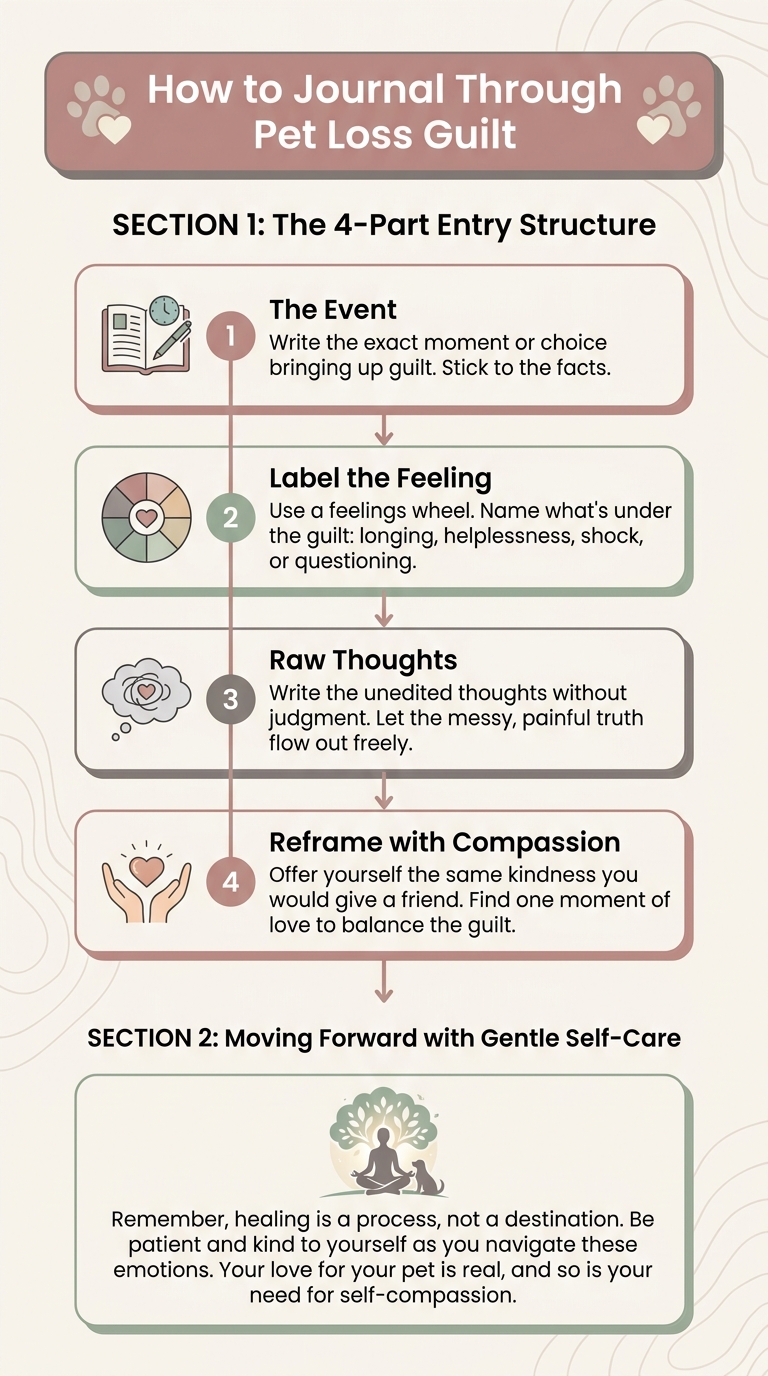
How to Start Journaling for Pet Loss Guilt: A Step-by-Step Guide
Now that you have a goal and a routine, it’s time to write your first entry. Take a short pause. Then set a timer for 5 to 10 minutes.
Use a simple four-part entry structure
Go through these four parts in order:
- The event: Write the exact moment or choice that’s bringing up guilt. Keep it short. Stick to the facts.
- Label the feeling: Use a feelings wheel to name what’s under the guilt. Maybe it’s longing, questioning, helplessness, or shock.
- Raw thoughts: Write the “should-haves” exactly the way they show up in your mind.
- The compassionate response: Answer those thoughts the way a kind friend would. Or write from your pet’s loving point of view. Say what you’d say to yourself if you were offering the same love you gave your pet.
This structure can help you move away from self-blame and toward a steadier response, especially when hindsight is making the moment seem bigger than it felt back then.
If the entry starts to feel too heavy, switch to one of the simpler writing methods below.
Pick the writing method that feels right today
You don’t have to write the same way every day. Match the method to your energy level:
- Guilt thoughts only - Use this when the feelings feel urgent and you just need to let them out.
- Guilt + compassionate response - Use this when you have enough energy to push back on the “should-haves.”
- Guilt + memory and gratitude - Use this when you want to remember your pet’s full life, not only the end.
Know when to pause and get support
If writing leaves you more upset than relieved, stop for now and do a grounding exercise to settle yourself. You can always come back later today or try again tomorrow.
If guilt stays intense or starts affecting sleep, appetite, or day-to-day life, journaling by itself may not be enough. Talking with a pet loss grief counselor or joining a pet loss support group can help a lot. Pet Memory Shop lists pet loss hotlines and phone support if you need help beyond the page.
These notes can make it easier to spot patterns when you look back at your entries later.
Keep going over time and connect journaling with remembrance
Review past entries to spot patterns and ease self-blame
When you feel ready, go back and read older entries in small pieces so you don't get overwhelmed. Try to spot patterns before judging any one choice on its own. Old entries can help you separate actual responsibility from hindsight, which can make past decisions seem much clearer than they felt in the moment.
If it helps, use a feelings wheel to put a name to what's sitting under the guilt: questioning, helplessness, emptiness, shock, or longing. That simple step can make the feeling easier to face, instead of letting it melt into self-blame.
It also helps to write down plain, specific moments of care you gave your pet: the vet visits, the late nights, the comfort you offered. Those details matter. They're proof of devotion, not failure.
Add memorial rituals that support healing
After you've spent some time reviewing your entries, you can bring remembrance into the practice too. Pet Memory Shop offers memorial items such as urns, grave markers, and memorial jewelry that can give you a quiet focal point while you write.
You can also use your journal to plan or record a personal ceremony that celebrates your pet's life. That way, the journal holds more than guilt alone. It makes room for grief, love, memory, and the full story of your bond.
Conclusion: Start small, write honestly, and let the practice grow
Keep reviewing entries, naming the feelings under guilt, and recording the care you gave. Add memorial rituals when they help. Keep the habit small. Start with one entry and let the practice grow.
FAQs
What if journaling makes my guilt feel worse?
It’s normal for grief to feel overwhelming. If journaling makes your guilt feel heavier, listen to yourself and take a step back. You don’t have to force yourself to write if it adds more pain.
You can set the journal aside for a bit and try something gentler instead, like quiet reflection or making a memorial to honor your beloved companion. If you need extra support, Pet Memory Shop offers resources and compassionate guidance.
How long should I keep a pet loss journal?
There’s no fixed timeline for keeping a pet loss journal.
Grief works on its own schedule, and that can look different from one person to the next. You may write every day for a few weeks, keep it up for a year, or come back to it in waves when you need a little comfort and room to sort through what you’re feeling.
Keep using your journal for as long as it gives you support, brings you peace, and helps you move through the loss.
Can journaling help after euthanasia guilt?
Yes. Journaling can help you process the guilt that often follows pet loss and euthanasia. It gives you a private place to put down the hard stuff: second-guessing, helplessness, sadness, and all the thoughts that keep circling in your head.
That matters because grief doesn’t move in a straight line. When you write things out, you’re not stuffing those feelings down or pretending they’re not there. You’re making room for them.
Journaling can also help you honor the bond you shared with your pet. You might write about a favorite memory, the care you gave, or the love that shaped your time together. In that way, writing isn’t just about pain. It can also be a small act of self-compassion.